Productivity
ThoughtSpot Reviews, Pricing, and Alternatives (January 2026)
ThoughtSpot pricing ranges from $100k to $1M+ annually. Compare consumption costs, semantic layer requirements, and top alternatives like Index in January 2026.

When you search for ThoughtSpot pricing, you'll find ranges from $100k to over $1 million annually, but nobody explains why the variance is so wide. The answer is consumption-based billing that charges per dashboard load, plus the engineering cost of building and maintaining a semantic layer that ThoughtSpot requires to function. We wrote this guide to break down the true cost of ownership, show you where ThoughtSpot excels and where it breaks, and compare it against alternatives that don't require a six-month implementation.
TLDR:
ThoughtSpot charges consumption-based pricing that can hit $5-6 per dashboard load
Search analytics requires heavy engineering to build rigid semantic layers before use
Index delivers natural language queries with minutes of setup vs weeks of modeling
Alternatives like Sigma, Preset, and Hex serve specific niches but lack general BI speed
Index offers AI-powered analytics with transparent per-seat pricing and no usage taxes
What is ThoughtSpot and How Does It Work?
The premise is search-driven analytics: a business user types "revenue by region 2025," and the system converts that natural language into SQL, queries your cloud warehouse (Snowflake, Databricks), and generates a chart.
But here is the brutal truth: the search bar is only as good as the modeling behind it. ThoughtSpot cannot effectively query raw tables. Data teams must build and maintain a rigid metadata layer ("Worksheets") to define every join, synonym, and relationship manually.
Core components include:
Search Data: The primary interface where users execute keyword-based queries.
SpotIQ: An automated engine that scans for anomalies, outliers, and correlations without user prompts.
Liveboards: Dashboards that support drill-downs instead of static reporting.
Embedded Analytics: SDKs for integrating search capabilities into external SaaS products.
This tool is strictly for the enterprise. It requires serious engineering resources to manage the data models before a single business user can type a question.
Why Consider ThoughtSpot Alternatives?
ThoughtSpot fits massive enterprises with pristine warehouses. If you don't have a dedicated engineering army, it breaks.
Pricing Punishes Curiosity
Most tools charge per user. ThoughtSpot charges for usage. Index takes a different approach with transparent per-seat pricing.
Under this consumption model, costs can hit 5-6 dollars per dashboard load. Every time a stakeholder refreshes a report, the meter runs.
Total cost of ownership becomes indefensible, often ranging from $100,000 to over $1 million annually. That capital is better spent on headcount.
Rigid Visualization Limits
Analysts hate feeling handcuffed. While adequate for basic charts, ThoughtSpot fails at nuance. It lacks bullet charts and Sankey diagrams required for detailed reporting.
If stakeholders need complex geospatial visuals or mapping, you hit a wall. You end up exporting data to Excel to build the chart you actually wanted.
The Engineering Tax
Search analytics sounds magical until you have to build it. It requires heavy lifting. Using the search interface demands a non-trivial amount of pre-work to map synonyms and relationships manually.
You aren't building general data models; you are building ThoughtSpot-specific logic. These models are inflexible for reuse in other tools. Combine restricted pivoting with no intermediate data layer, and maintenance becomes a nightmare.
Best ThoughtSpot Alternatives in January 2026
Index (Best Overall Alternative)
Index was built to kill the "enterprise" bloat. ThoughtSpot works, but it drags six-figure contracts and opaque consumption models with it. Index builds analytics for tech teams who need answers now. Not next quarter.
What they offer:
Index AI for plain English queries that generate reliable charts using natural language query tools
Visual explorer and SQL editor for deeper research
Direct connections to cloud warehouses like Snowflake and BigQuery
Prebuilt SaaS metrics and templates
White-label customer dashboards for your customers
Good for: Tech-driven teams of 20–500 employees with lean data teams.
Limitation: Index focuses on speed and self-service. We do not support legacy on-premise deployments or waterfall reporting structures.
Bottom line: Index delivers ThoughtSpot's promise of natural language search without the implementation tax. Setup takes minutes. Pricing is transparent.
Sigma Computing
Sigma forces your warehouse to look like a spreadsheet. It bridges the gap between Snowflake and Excel.
What they offer:
Spreadsheet interface that compiles to SQL
Live warehouse connections
Collaborative editing
Good for: Finance and Ops teams who refuse to leave spreadsheets.
Limitation: It feels like Excel because it is Excel. Visualizations are rigid. It lacks the generative analysis features found in Index.
Bottom line: Great for spreadsheet die-hards. Weak for general BI.
Preset
Preset is managed Apache Superset.
What they offer:
40+ visualization types
No-code chart builder
Row-level security
Good for: Engineering teams who know Superset and want someone else to host it.
Limitation: You inherit open-source complexity. It requires technical expertise to maintain. No native natural language querying.
Bottom line: Good for engineers. Too technical for business users.
Hex
Hex is a collaborative notebook for data scientists.
What they offer:
SQL and Python mixed in cells
Version control
Data apps from notebooks
Good for: Data scientists needing code-heavy workflows.
Limitation: It is expensive. The cell-based architecture scares off non-technical business users who just want answers.
Bottom line: Perfect for data science. Overkill for business intelligence.
Metabase
The default free option.
What they offer:
Simple query builder
Free self-hosted version
Basic dashboards
Good for: Bootstrapped startups with $0 budget.
Limitation: It chokes on complex data. Performance creates bottlenecks at scale.
Bottom line: A fine starting point. You will eventually outgrow it when you need deeper analysis or governance.
Feature Comparison: ThoughtSpot vs Top Alternatives
Sales slides lie about deployment. Every tool claims to be easy, but the engineering tax varies from zero to a full-time team. You need to know which search analytics tools impose a heavy maintenance burden and which ones simply work.
We broke down the actual execution requirements below.
Capability | ThoughtSpot | Index | Sigma Computing | Preset | Hex | Metabase |
|---|---|---|---|---|---|---|
Search Analytics & AI | Yes (Search-based) | Yes (AI-powered) | No | No | Limited (Magic AI) | No |
Time to Value | Weeks to months | Minutes | Days | Days to weeks | Hours | Hours |
Prebuilt Metrics | Limited | Yes (SaaS-focused) | No | No | No | No |
Embedded Dashboards | Yes (Add-on cost) | Yes (Included) | Limited | Limited | Yes | Limited |
Collaboration | Yes | Yes | Yes | Limited | Yes | Limited |
SQL Required | Optional | Optional | Optional | Optional | Yes | Optional |
Why Index is the Best ThoughtSpot Alternative
ThoughtSpot requires too much engineering overhead. You want search analytics that work out of the box, but you often end up with a massive implementation project to map synonyms and define a semantic layer. If that layer is slightly off, the answers are wrong.
We built Index to fix the friction most thoughtspot alternatives ignore.
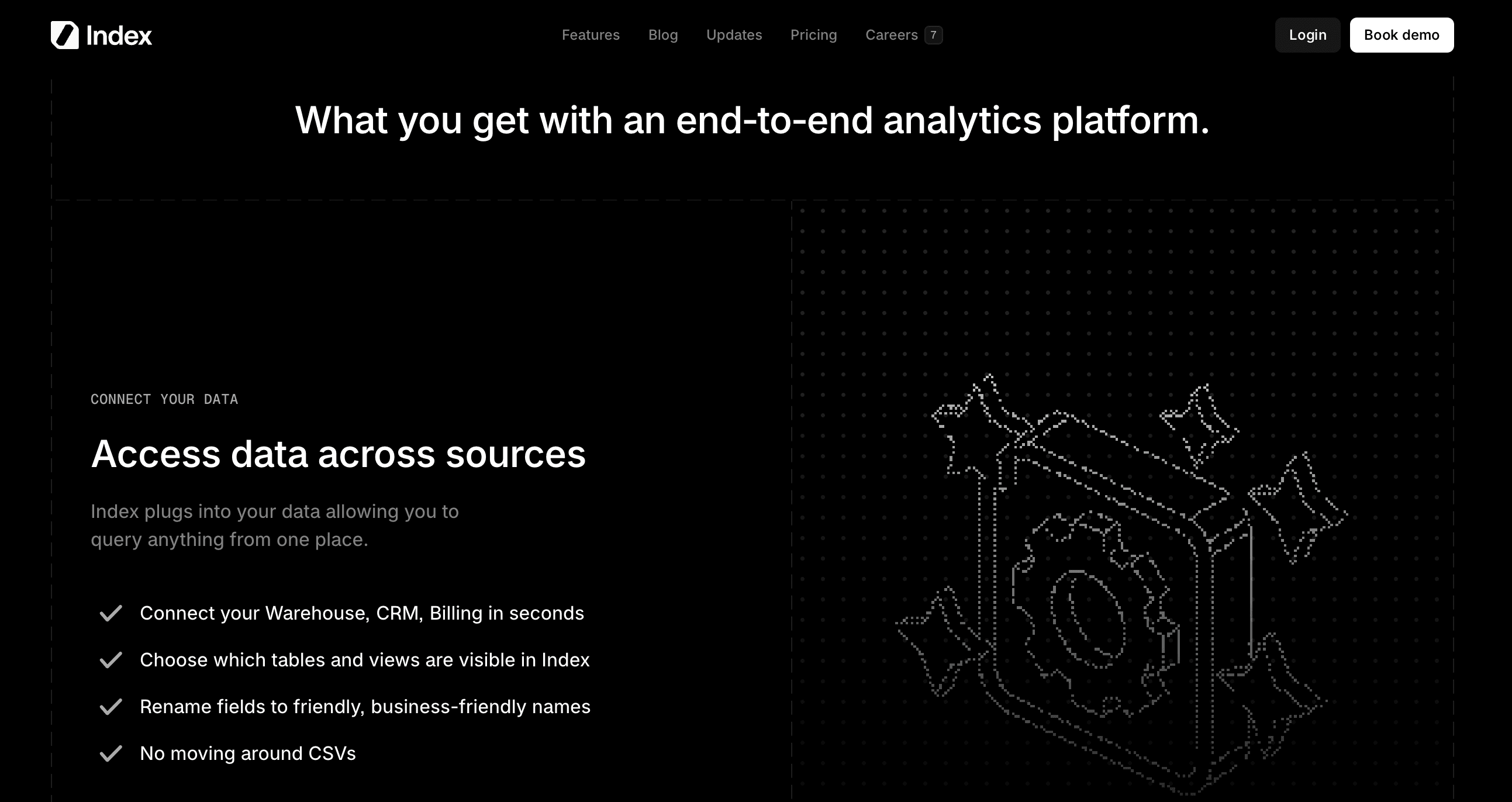
You connect your database. The AI understands your schema. You get answers. We stripped out the need for a heavy, manual semantic layer to make data analysis as simple as having a conversation.
Predictable Pricing
Consumption pricing is a tax on curiosity. It discourages your team from researching data because every query costs money. We reject that model.
Per-seat pricing eliminates surprise overages.
Unlimited queries mean your team can drill down without fear of hitting limits.
Predictable invoices keep your finance team happy.
Real-Time Collaboration
Most tools treat analysis as a solo, offline event. We built Index to be multiplayer. You edit charts together in real-time, tag teammates on specific metrics, and resolve threads right on the dashboard. Whether you are doing internal reporting or embedding dashboards for your customers, the workflow remains fluid and collaborative.
Final Thoughts on Search Analytics Without the Overhead
Most search analytics tools promise magic but deliver months of setup work. ThoughtSpot requires perfect semantic layers. Index skips that step and reads your schema directly. You get natural language queries without the engineering tax. Connect your warehouse and see how fast you can move.
FAQs
Why should you consider moving away from ThoughtSpot?
ThoughtSpot's consumption pricing model can cost $100,000 to over $1 million annually, charging up to $5-6 per dashboard load. If you lack a dedicated engineering team to build and maintain the rigid semantic layer (Worksheets), or if unpredictable usage costs are eating your budget, it's time to look at alternatives that offer transparent per-seat pricing and faster setup.
What features should you focus on when comparing ThoughtSpot alternatives?
Look for natural language query capabilities that work without heavy semantic modeling, transparent per-seat pricing instead of consumption-based billing, and fast time-to-value (minutes to days, not weeks). Also focus on tools that support both technical and non-technical users, offer flexible visualization options, and connect directly to your cloud warehouse without requiring extensive pre-work.
How long does it take to implement Index compared to ThoughtSpot?
Index connects to your database and delivers answers in minutes, while ThoughtSpot typically requires weeks to months of implementation. ThoughtSpot demands material upfront engineering to map synonyms, define relationships, and build Worksheets before business users can run queries. Index eliminates that semantic layer tax by understanding your schema automatically.
Can I get natural language analytics without the engineering overhead?
Yes. Index AI generates reliable charts from plain English questions without requiring you to manually define joins, synonyms, and relationships. Unlike ThoughtSpot's search, which breaks when the semantic layer isn't perfect, Index works directly with your schema and delivers accurate results from day one without the maintenance burden.