Productivity
Best Natural Language Query Tools for Data Analysis (November 2025)
Compare the best natural language query tools for data analysis in November 2025. Index, ThoughtSpot, Tableau, and more - find the right AI data chat platform.

Long gone are the days of submitting SQL requests and waiting for someone on the data team to get back to you. AI data chat tools let you ask questions about your data the same way you'd ask a colleague, and they return results in seconds instead of days. We tested the leading platforms to see which ones handle real business questions accurately and which ones still need too much hand-holding to be useful.
TLDR:
Natural language query lets you ask data questions in plain English and get charts in seconds.
Index delivers sub-second query responses with pre-built SaaS metrics and setup in minutes.
ThoughtSpot and Tableau require weeks of implementation versus Index's instant deployment.
Most tools treat conversational queries as add-ons; Index builds AI-powered chat as core functionality.
Index offers real-time collaboration and white-labeled customer dashboards without engineering work.
What is Natural Language Query?
Natural language query lets you ask questions about your data the same way you'd ask a colleague. Instead of writing SQL or building complex filters, you type "show me revenue by region last quarter" and get back a chart or table.
The tech interprets your plain English question, figures out which data to pull, and generates the visualization automatically. For more technical terms and concepts, check out our glossary.
Natural language query tools translate conversational requests into the technical queries that databases understand, then return results in seconds.
Most business questions don't need a data analyst to answer them. When your sales team wants to check pipeline velocity or your product manager needs feature adoption rates, they shouldn't wait days for someone to write SQL. Natural language query removes that bottleneck.
The result is faster decisions and less dependency on overloaded data teams. Anyone who can articulate a question can now analyze data independently.
How We Ranked These Natural Language Query Tools
We tested each tool across six dimensions that determine how quickly teams can extract answers from their data.
Ease of use tracks whether non-technical users can ask questions and interpret results without training. We tested how each tool handles ambiguous queries and whether it guides users toward clearer questions.
Data integration understand which sources connect natively and how much setup is required. Tools that support warehouses, databases, and SaaS apps without ETL pipelines scored higher.
AI accuracy measures how often the generated query matches the user's intent. We looked at error rates on common business questions and whether the tool explains its interpretation.
Implementation speed captures time from signup to first insight. Security covers compliance certifications and data governance controls. Collaborative functionality includes real-time co-editing, commenting, and sharing capabilities.
Best Overall Natural Language Query Tool: Index
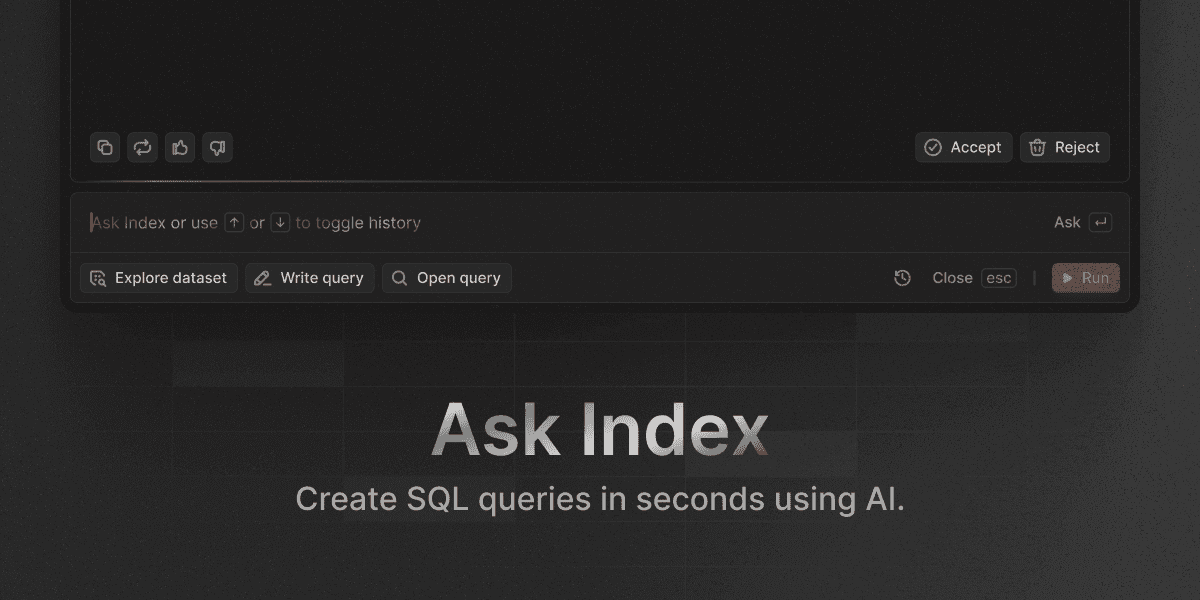
Index connects to your data warehouse and answers questions in plain English. Ask "compare Q3 customer acquisition cost to last year" and get accurate results without clarifying what you meant.
The tool includes pre-built metrics for SaaS businesses: retention cohorts, pipeline velocity, and unit economics. Connect Snowflake or BigQuery and common KPIs populate automatically.
Query response times stay under one second on large datasets. Fast execution lets you test hypotheses in real time instead of queuing requests.
Multiple users can refine the same chart simultaneously with live cursors and inline comments. When someone asks a follow-up during a meeting, you answer it together on screen.
For customer-facing analytics, Index provides white-labeled dashboards with embedding and per-customer data isolation built in.
ThoughtSpot
ThoughtSpot markets Spotter as an AI agent for analytics, answering data questions through conversation. The search-driven approach aims to remove SQL dependency.
What they offer
Natural language search with AI query interpretation, interactive Liveboards for real-time visualization, embedded analytics for external applications, and Spotter, their agentic AI analyst that surfaces automated insights.
Good for
Large enterprises with extensive data governance requirements and dedicated implementation resources. Organizations that can invest months in setup and maintain complex analytics infrastructure.
Limitation
The modeling process adds friction to deployment. Search constructs need more flexibility in supported phrasing, limiting how users can ask questions. Setup requirements slow teams that need immediate analytics access.
Bottom line
ThoughtSpot delivers enterprise-grade features but demands implementation effort that delays time-to-value for smaller, agile teams.
Tableau
Tableau added natural language querying through Tableau Pulse Q&A and Tableau Agent. Users can ask questions conversationally and generate visualizations without writing queries, though the product remains visualization-first with AI layered on top.
What they offer
Natural language queries through Pulse Q&A, visualization and dashboard creation tools, desktop authoring for complex charts, and enterprise security with governance controls.
Good for
Organizations with dedicated visualization teams that need sophisticated chart creation and already have Tableau expertise in-house.
Limitation
Natural language capabilities work as add-ons instead of a core functionality. Most analytical tasks still require understanding traditional Tableau interfaces. The interface complexity creates barriers for non-technical users who want quick answers without learning visualization software.
Bottom line
Tableau excels at visualization depth but treats natural language querying as a secondary feature.
Microsoft Power BI
Microsoft Power BI includes Q&A natural language query functionality within its business intelligence suite. The tool leads on raw user count due to aggressive per-seat pricing bundled with Microsoft licenses.
Power BI Q&A offers a conversational query interface, native integration with Microsoft 365 and Azure services, and pre-built connectors for Dynamics, SharePoint, and Teams. Per-seat costs remain low, especially for existing Microsoft customers.
The tool fits organizations already running on Microsoft infrastructure that want entry-level natural language capabilities without additional vendor relationships or procurement cycles.
The Q&A feature handles only straightforward questions. Complex analysis still requires manual dashboard construction through Power BI Desktop. The natural language layer works best as a query shortcut instead of a full conversational analytics experience.
Power BI delivers budget-conscious access to basic natural language querying for Microsoft-centric teams but lacks depth for sophisticated data conversations.
Looker
Looker uses LookML, a modeling language that defines metrics and governance centrally, focusing on controlled data definitions over conversational interfaces.
What they offer
LookML semantic modeling for centralized business logic, governed metrics with consistent definitions across teams, cloud-native architecture with API-first integration, and native connections to Google Cloud services.
Good for
Data-mature organizations that need strict governance and centralized metric control with technical teams capable of writing and maintaining LookML code.
Limitation
Natural language query features lag behind visualization capabilities. Business users must grasp LookML concepts and modeling structures, creating friction for teams wanting immediate, conversational data access without learning a proprietary modeling language.
Bottom line
Looker focuses on governance and semantic consistency over conversational ease, making it better suited for technical data teams than business users seeking natural language interactions.
Metabase
Metabase offers open-source business intelligence with basic natural language query capabilities through its question-building interface.
What they offer
Open-source BI with basic natural language features, simple dashboard creation and sharing, self-hosted and cloud deployment options, and SQL query builder with visual interface.
Good for
Small teams with limited budgets seeking basic analytics capabilities and willing to manage technical implementation details.
Limitation
Natural language querying remains rudimentary compared to AI-powered competitors. Users rely primarily on manual query building and lack conversational capabilities for sophisticated data exploration.
Bottom line
Metabase provides affordable basic analytics but falls short of delivering the advanced natural language query experience teams need for efficient data analysis.
Feature Comparison Table of Natural Language Query Tools
Feature | Index | ThoughtSpot | Tableau | Power BI | Looker | Metabase |
|---|---|---|---|---|---|---|
Setup Time | Minutes | Weeks | Weeks | Days | Weeks | Days |
Natural Language Quality | Advanced AI | Advanced AI | Moderate | Basic | Limited | Basic |
Pre-built Metrics | Yes | Limited | No | Limited | No | No |
Real-time Collaboration | Yes | Yes | Limited | Yes | Limited | Limited |
Customer Dashboards | Yes | Yes | No | No | Limited | No |
Pricing Model | Per-seat | Enterprise | Per-seat | Per-seat | Enterprise | Open source |
Index and ThoughtSpot both offer advanced AI-powered query interpretation, though Index deploys in minutes versus weeks-long implementations for ThoughtSpot. Tableau and Looker treat text-to-SQL as an add-on instead of a core functionality. Power BI and Metabase provide basic conversational query support with limited accuracy on complex requests.
Why Index is the Best Natural Language Query Tool
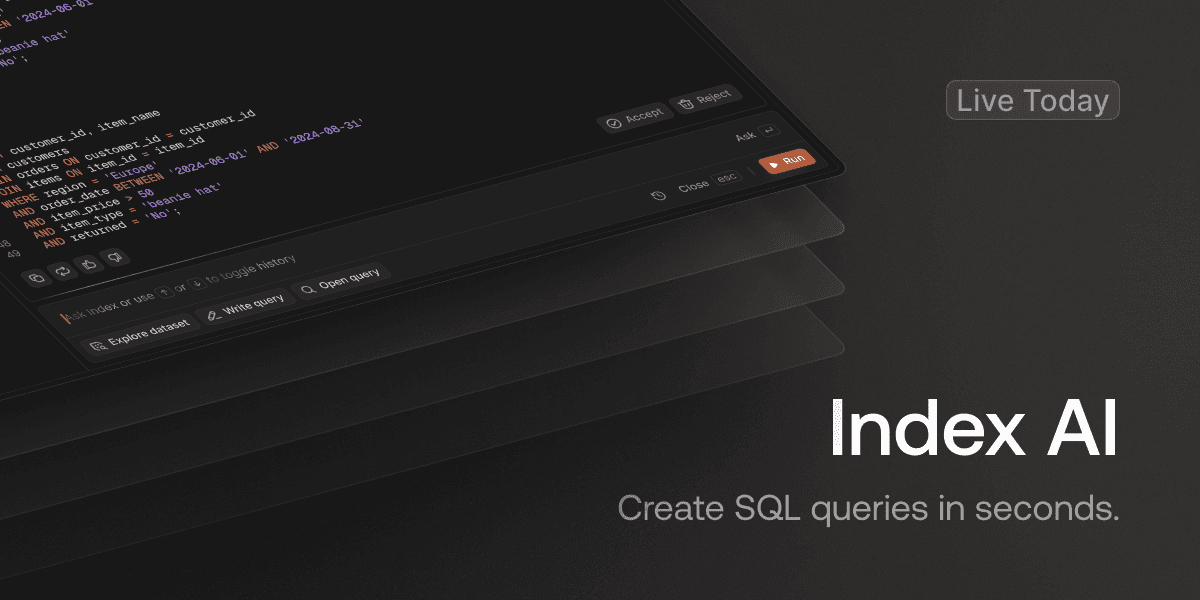
Index connects to your data in minutes and ships with pre-built metrics that eliminate the blank-slate problem common in other tools. Gartner reports 85% of customer service leaders plan to test conversational GenAI, with chatbots becoming a primary channel for roughly 25% of organizations by 2027.
Final thoughts on natural language query software
When plain English data queries work correctly, your team stops depending on analysts for every chart and metric. Index answers questions in under a second and comes with pre-built KPIs that eliminate setup friction. You can connect your warehouse and start analyzing data before lunch. Ask your data questions the same way you'd ask during a meeting.
FAQ
What is natural language query and how does it work?
Natural language query lets you ask questions about your data in plain English instead of writing SQL or building complex filters. The tool interprets your conversational request, translates it into a database query, and returns charts or tables in seconds without any technical knowledge required.
How long does it take to set up a natural language query tool?
Setup time varies substantially by tool. Index connects to your data warehouse in minutes, while enterprise platforms like ThoughtSpot and Looker typically require weeks of implementation and modeling work before teams can start querying data.
Can non-technical users really analyze data without SQL knowledge?
Yes, but accuracy depends on the tool's AI capabilities. Advanced natural language query tools like Index and ThoughtSpot interpret ambiguous questions correctly and guide users toward clearer phrasing, while basic implementations in Power BI and Metabase handle only straightforward requests and still require manual dashboard construction for complex analysis.
What data sources can natural language query tools connect to?
Most tools connect to cloud data warehouses like Snowflake, BigQuery, and Redshift, plus relational databases like Postgres. Index and ThoughtSpot also offer native integrations with SaaS applications (Stripe, Salesforce, HubSpot) without requiring separate ETL pipelines, while others focus primarily on database connections.
When should I choose a natural language query tool over traditional BI?
Consider switching if your team spends more than 10 hours per week waiting for analysts to answer recurring questions about metrics like retention, conversion rates, or pipeline velocity. Natural language query tools remove the bottleneck for teams with accessible data sources who need self-service analysis without heavy SQL dependency.